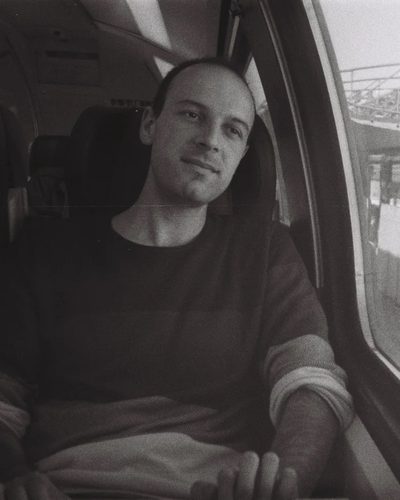
Damjan Jovičin
Damjan Jovičin (1995, Belgrade) is a composer and pianist. He finished his Bachelor and Master studies at Faculty of Music in Belgrade, and is currently studying PhD studies in the class of professor Zoran Erić. He spent one semester at Franz Liszt Academy of Music in Budapest as a part of ERASMUS program. He is an active participant of many national and international festivals where his compositions were premiered. Some of them include: Darmstädter Ferienkurse (Germany), ISA Festival (Austria), Time of Music (Finland), Soundmine (Belgium), Walden Creative Musicians Retreat (USA), BEMUS (Serbia), International Composer’s Review (Serbia), KoMA (Serbia), FESTUM (Serbia), CEME Festival (Israel)... He received the commission for the 49th edition of Belgrade Music Festival and composed an orchestral piece Mathematical Dream which was premiered by RTS symphony orchestra at Kolarac Endowment. Besides concert music, he leads a gamelan ensemble, traditional singing group, composes music for multimedia art and performs as a pianist and conductor.
Three months at Zvjezdane Staze as one of the five artists of the first season, selected through the Open Call 2024.
From the residency
During my stay in Mijakovići, few things have significantly influenced my work. The Medieval town of Bobovac served as a podium for my imagination on the topic of possible pasts. What was the music? what was the spirituality back then? My ethnomusicological mind always strives to keep track of sources. My piece Metamorphosis should emphasize transformative character of music with its folklore. One of the elements that I chose for the music in Metamorphosis, are trills and polyphonic singing that is widespread across the Balkans and which constitutes a recognisable folk sound.
The element of spirituality which Minja and I were researching about brought us to the poem Molitva Bogumilova, written by Desanka Maksimović and which opens the Metamorphosis performance. The poem is in the form of a prayer of a medieval gnostic from the Balkan Areas of Macedonia, Raška, Dalmatia and Bosnia. If we imagine a sanctuary at Bobovac, Desanka’s words seem to create certain mood of rite, which could be interpreted as reimagining the rite.
The gamelan percussion score I created and named it Eclipse(Pomračenje), is the instrumental part that follows Eclipse in the Metamorphosis scenario by Minja Jovičin. The music consist of interaction of dense rhythms in soloist part and very dispersed accompaniment in the rest of gamelan.
From many thoughts that came across my mind during my stay in Mijakovići, what I would point out is the permanent change. Permanent change in nature, and in my ideas about music. While planning for the final presentation, my mind was saturated with ideas on Balkan folklore and the interaction of all parts of it, even the most contrasting types of folklore. For me, that is the puzzle that needs to be solved. My work as a music anthropologist is still long way to go...
At Zvjezdane Staze
External
.png)
The residencies of the first season of Zvjezdane Staze (2024) were funded by the European Union under the Culture Moves Europe programme, implemented by the Goethe-Institut. Views and opinions expressed are those of the author(s) only and do not necessarily reflect those of the European Union or the Goethe-Institut. Neither the European Union nor the granting authority can be held responsible for them.