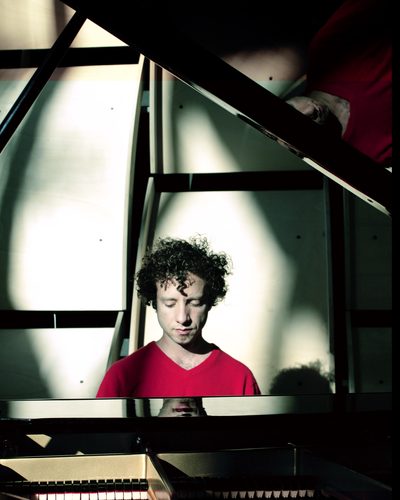
Manuel Pessoa de Lima
Manuel Pessoa de Lima is a Brazilian performer-composer, creating unique performances unraveling a mesh of fictional and biographical narratives, highlighting the conflicts and doubts around the creative process, including political questionings, in an intersectional perspective.
Classically trained, with a long academic trajectory including a bachelor’s in music composition, a masters in musical analysis, and a fully funded scholarship in the performer-composer doctoral program at CalArts, Manuel breaks academic seriousness while embracing a process-based practice, which spans from experimental music to theater, lecture-performance and installation.
Released a sound collage work - 36 English to Portuguese Lessons - through Cafe Oto, and the album - Realejo - for Organ, whistles and electronics, by the Black Truffle label. Presented solos at innumerous international festivals, such as Supersense (AU), Oscillation Festival (BE), Send-Receive (CA), Música Estranha (BR), Summerfest Schloss Solitude (DE), Tectonics Festival (UK), BAM Fest (DE), and Novas Frequências (BR). Is currently based in Berlin.
Portrait · Jordan Dykstra
Three months at Zvjezdane Staze as one of the five artists of the first season, selected through the Open Call 2024.
Statement
I've been sitting in a crossroad, in between worlds, for so long, that my place became this ever changing "inter-something". When I saw the two pictures, the one of "Stone of Varda", and the other, "Medulin", they strung this same chord: the one of transitoriety.
I am a pianist, and sometimes when I look at the piano bench I ask myself something similar to the inscriptions in Cyrillic: "this [piano] bench, whose was it? Whose is it now? Whose will it be?" Of course, with that I am hinting on a broader question, which is not about "who will be next pianist-king", but the actual meaning of the throne itself, the meaning of virtuosity and power.
That is answered to me by the other inscription, found on Medulin. Virtuosity never interested me, and I am critical of the power-knowledge dispositive present on conservative institutions, like conservatories. Now, already out of academia (finished my doctoral), I came from Brazil to try the free lance artist life in Berlin, and found myself, in my early forties, living with such a degree of uncertainty, that I asked myself, "what is this life?". Well, what did I expect? If I renounced the "fight for the throne", I can't expect such security. The poem at Medulin is reassuring: "I never had much. Nor lacked anything, but shared", and although I am not dead yet, that could be an epitaph I would be glad to have for myself.
During and after the residency
External
.png)
The residencies of the first season of Zvjezdane Staze (2024) were funded by the European Union under the Culture Moves Europe programme, implemented by the Goethe-Institut. Views and opinions expressed are those of the author(s) only and do not necessarily reflect those of the European Union or the Goethe-Institut. Neither the European Union nor the granting authority can be held responsible for them.