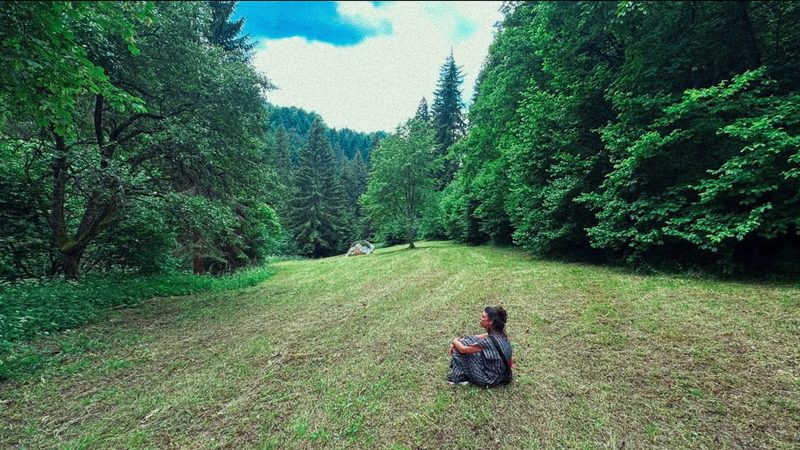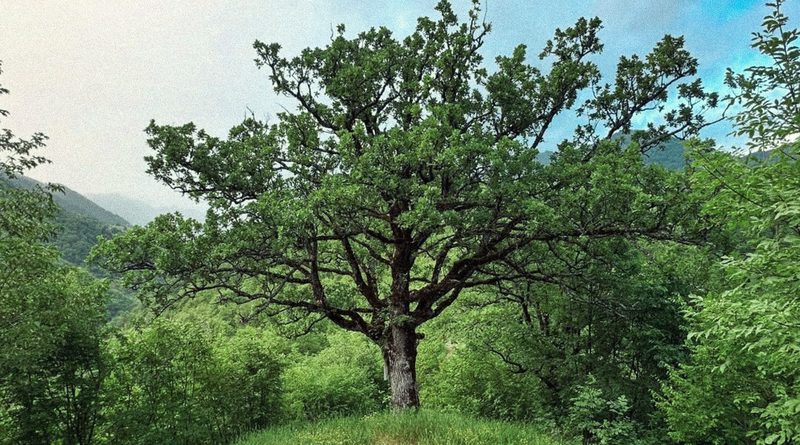
Alija Kamber and Azra Jašarević arrived in Mijakovići on 17 June 2026 and left on the twenty-second. The programme announced under the name Dvonoćje occupied three days in the middle of that stay. The name counts nights, two of them, taken around the summer solstice; the residency that held them ran to five, and the days without programme carried most of what gave the edition its shape.
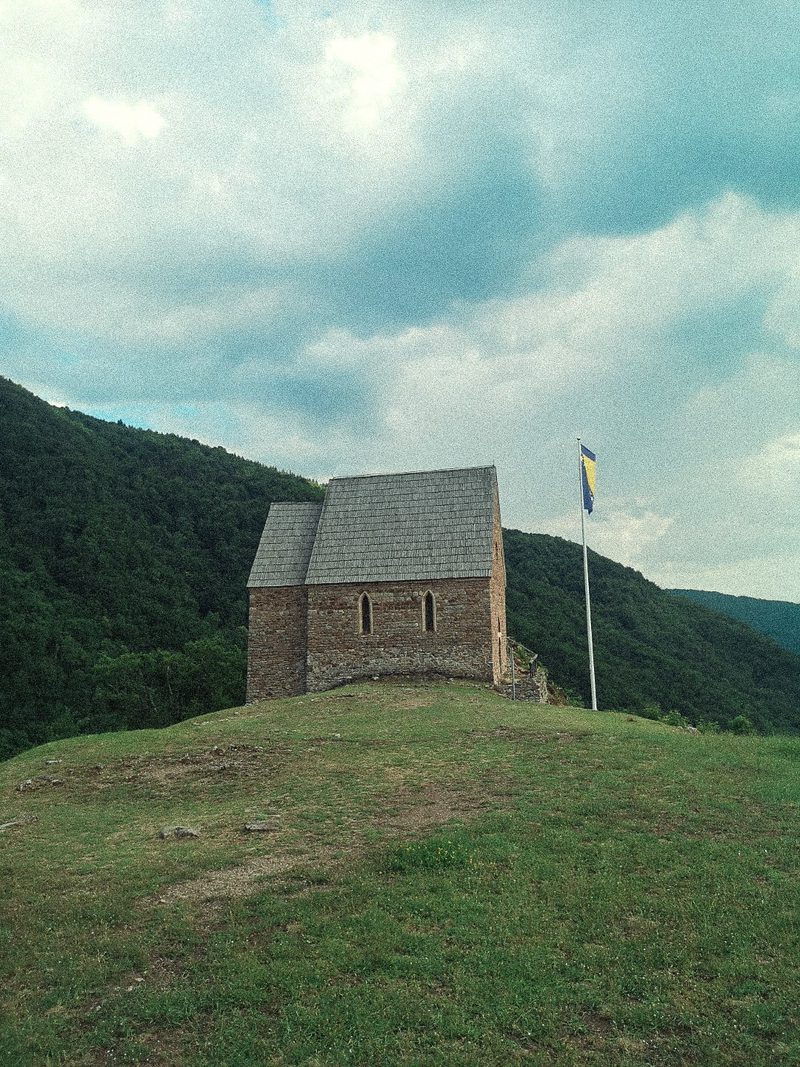
On the afternoon of 18 June we went up to Bobovac, the fortified seat begun by ban Stjepan II Kotromanić shortly before the middle of the fourteenth century, held by the Bosnian kings until 1463 and a ruin ever since. The description under which the site is registered as a national monument places it on the southern slopes of the Dragovska and Mijakovska poljica, above the confluence of the Mijakovska river and the Bukovica, close to the villages of Dragovići and Mijakovići. Mijakovići lies higher, on Perun, so the fortress is reached from above, and the village in which the residency stands is inside the topographic definition of the monument rather than adjacent to it. In the cistern beside one of the towers there is still water, and in the water something lives that rises to the surface after insects. We take it for a mrmoljak, a newt.
We drove up to Bobovište on 19 June in a TAM lorry, the Yugoslav-built type still in service on these slopes. Bobovište is the field and orchard of Šaban and Nadža Ibrišimović, who are neighbours. The afternoon went in mowing their meadow, where we raked more than we cut, in picking ašlame, the firm-fleshed cherry that grows on their trees, and in gathering zova and žara, elder and nettle. The cut grass stayed on the meadow to dry, since hay is not carried on the day it is cut; the elder and the nettle came back with us and were laid out for tea, and the elder went into syrup as well. Kantarion stood in flower along the same margins and was left where it was, since it is picked in July, and July belongs to a later residency period.
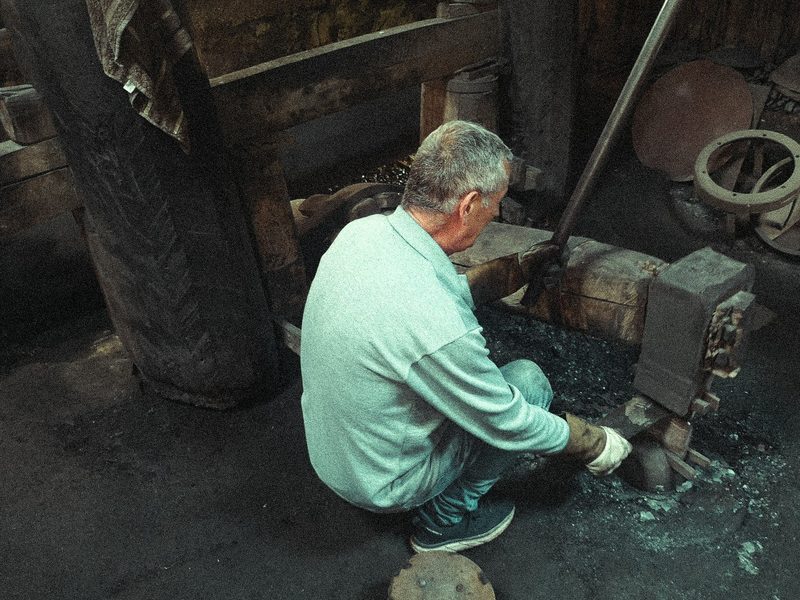
On 20 June we went to Oćevija, where three water-powered forges remain in operation, kept by the Jozeljić, Gogić and Vijačkić families and protected as a national monument of Bosnia and Herzegovina. We spent the visit at Mijo Jozeljić's majdan, where the hammer is driven by the river Oćevica and the iron heated on ćumur, charcoal burnt for the purpose, and left with a kazan, a trnokop, an axe and a peka. All four are in use at the residency. A monument of this order is sustained by the market for what it makes; the visit that ends in a purchase does more to keep it standing than the visit that ends in a photograph.
That afternoon, at around five, Alija Kamber opened Distant Relatives. Through 2020 and 2021, when contact was prohibited, he photographed his parents daily from the balcony while they stood at the ground-floor window below him, and the series holds the small variations of those months: mood, posture, what they had chosen to put on that morning. In Mijakovići twelve prints were hung in plain pine frames, seven on the door of the wooden privy in the yard and five on the logs of the outbuilding beside it: photographs of windows mounted on a threshold that now stands open.
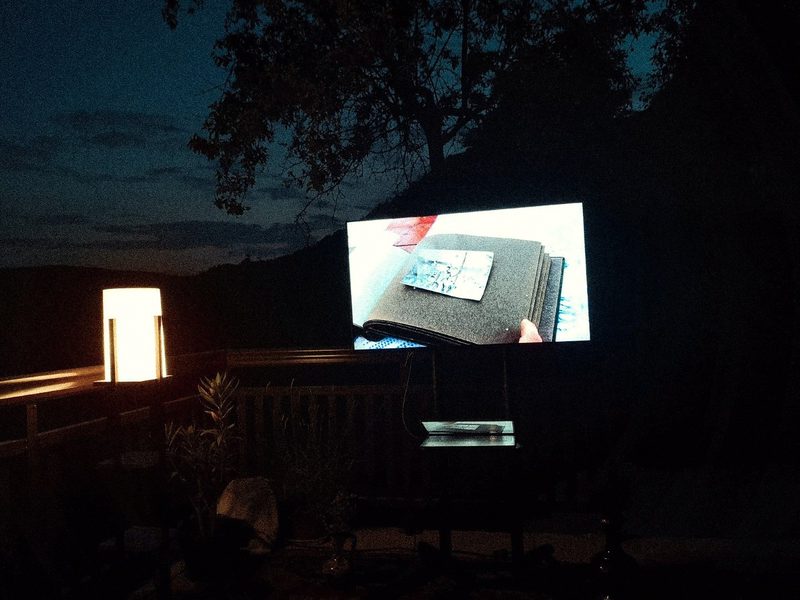
On 21 June, the solstice, Pčelarenje pred Kijamet was screened on the terrace at 21:00, introduced by Azra Jašarević, who made the film with her sister Larisa. The conversation that followed proceeded without chairs turned toward a front and without a division between speaker and audience; people said what they thought, asked her about the film, and were asked in turn about their own hives. Bees are kept in a number of households in Mijakovići. A film about honey thinning across Bosnia and Herzegovina had come to a place where the knowledge it documents is held by the people watching it.
Neither the meadow nor the forge required an audience. The mowing was due that week whether or not anyone had come to make work; the elder was in flower and would not wait; the forge was open and short of customers. The artists entered the week on those terms, and both days out ended in something that has since been dried, boiled down, or put to use: elder in the jar, an axe against the wall, hay left on the meadow until it was ready and carried in after the week was over.